Upon request, the EA (Environment Agency) can provide water flow maps for any part of the Stour catchment area. These show the predicted flow routes/pathways, with risk based on slope and land use. They are used by the EA and partners to identify locations to deliver flood mitigation measures such as hedgerows, tree planting and the creation of ponds/scrapes/bunds. The objective is to hold back the water before it enters a watercourse. The example below is one of 3 sent to SAFAG covering the Brailes area.
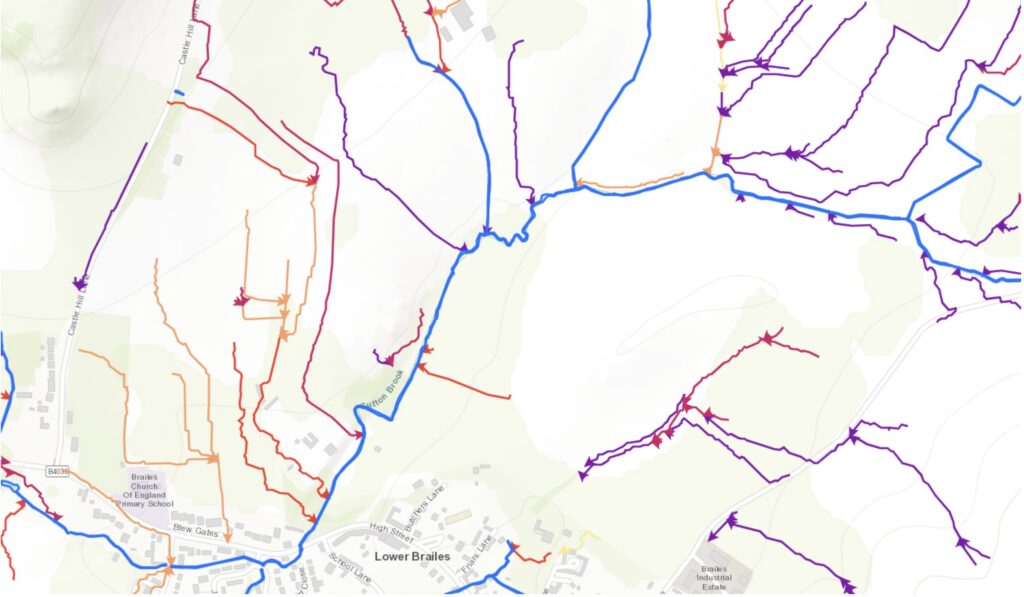
Arrows and the flow routes-blue is the channel. Purple-very high risk, red-high risk, paler red-medium risk, orange-low risk and yellow (if shown)-very low risk.
There is currently an evolving strategy, now being adopted by most of the key agencies, including the EA and SRT (Severn Rivers Trust), which aims to capture water where it falls, thereby reducing the flood impact on watercourses. SAFAG also supports this objective as it reduces the reliance on leaky woody dams which have a finite life span. They can be costly and time consuming to maintain/repair and are prone to failure (water-damaged/dislodged posts) during excessive flooding conditions, with erosion of the watercourse banks now being a regular problem. In contrast ponds, bunds, scrapes, wetlands and tree planting are more cost effective to create and require very little maintenance. They also deliver environmental and wildlife benefits.
Where it is appropriate to do so, leaky woody dams can still play an important role in flood mitigation, especially where there is landowner resistance to the other options.
There was a special meeting of STC on 16th October to review and consider the budgets and funding requirements for the various working groups of the council for the financial year 2026/2027.
Brian Cooper and John Dinnie attended on behalf of SAFAG, with the former having prepared and distributed, in advance of the meeting, a detailed report on SAFAG’s financial position. This included the estimated future net expenditure for 2026/2027, based on the projected intervention assessment activity planned by the team for the winter of 2025 and the spring of 2026. If STC can allocate £5,000 to the Maintenance Fund, it’s estimated that, by using some of SAFAG’s existing funds (Project and General-a total of £12,500) it should be possible to cover the projected expenditure of around £25,000. However, this is only a short- term solution for 2026/2027, and STC will need to consider how to fund SAFAG over the longer term, because an annual payment of £5,000 to the Maintenance Fund is unlikely to be sufficient.
Responding to a spate of recently submitted and pending planning applications, the local pressure group, Save our Shipston (SOS) organised a public meeting on 19th October at the Townsend Hall. The objective was to encourage residents to become more aware of the potential impact on the local infrastructure and to be proactive in responding/objecting to planning applications which, if all were to be successful, could result in an additional 1,700 new homes being built. Attendees included CPRE (Council
for the Preservation of Rural England), local and District Councillors as well as the local MP.
Because Shipston is prone to flooding from the River Stour, SAFAG was invited to participate, with Mike McCarthy and John Dinnie in attendance to respond to questions from the residents and other interested parties. The desktop display boards were used to visually support additional information, including flood awareness flyers. The event was both well organised and well attended. It was a surprise that no questions arose during the main forum about flooding, even though it has been widely quoted as being a concern across all pending and submitted planning applications. Both before and after the meeting, there was a large amount of interest in the display stand covering SAFAG’s activities, and the identified risk of flooding within Shipston.
Mike McCarthy attended the October meeting of LCFAG (Long Compton Flood Action Group). Attendees included Mark Banning of the WCC Flood team, who intends to prepare a business case for financial support, which is likely to be PFR (property flood resilience) based. If successful, funding will probably be available in 2027. There was much debate about the maintenance state of the various culverts (including blockages) and ditches within the village. A resilience team is being set up. Long Compton Parish Council does have a funding reserve for flood related works but intend to retain this at the present time to support LCFAG, as and when required. SAFAG was asked, for the time being, to continue with the maintenance responsibilities for the existing interventions in and around Long Compton (157 leaky dams). LCFAG and the parish council may consider financial support for new NFM (Natural Flood Management) measures, if suitable local opportunities were to arise. SAFAG will continue to offer support, advice and knowledge to LCFAG, until the group becomes more self-sufficient.
At the October meeting of STC, SAFAG requested the creation (from SAFAG funds) of a fixed budget amount to action time critical repairs on interventions, before the quote could be approved at the next regular TC meeting. Following a constructive/positive suggestion from Councillor Ian Cooper, which was supported by the councillors in attendance, the original request was withdrawn in favour of the proposed alternative.
For clarity, and the avoidance of doubt, this would be the procedure to follow, Where the repairs are identified as time critical, SAFAG can obtain the quote as usual from the contractor and, if satisfactory, arrange for the repairs/upgrades to be carried out. A SAFAG site visit will then be made to inspect the works carried out. The invoice will then be submitted to STC for scrutiny and, if approved, the appropriate payment authorisation. It’s only envisaged this may occur in early autumn, ahead of the adverse winter weather conditions, and when all other key requirements are met-landowner consent, access, suitable weather and ground conditions, contractor availability and acceptable quote.
Mike McCarthy attended the South Warwickshire Local Climate Engagement Event in Leamington Spa on 17th October. The sessions were primarily aimed at energy and biodiversity. Attendees included SDC Councillors Dave Passingham and Olivia Hatch, Warwicks Wildlife and Rainveer Mahal (WCC Flood Team), together with a number of climate/nature-based organisations. Of particular interest to SAFAG was a workshop presented by Great Alne Flood Group. They explained how they had successfully tackled a total of 114 regularly blocked drains/ditches/gulleys in the village. Their structured process may be of interest to both Brailes Parish Council and LCFAG.
A screenshot of the Great Alne Plan is shown at the end of this report. WCC came in for a lot of heavy criticism for the lack of maintenance/clearing of drains across the county.
One of the exhibition stalls was run by Warwicks Wildlife Trust, who have a dedicated Farming and Wildlife Advisory Group (FWAG). They work with the farming community (including in the Stour catchment area) to promote and improve farming practices, which includes measures which contribute to flood mitigation. Mike MCarthy has requested a meeting to discuss the opportunities and benefits this can provide. SAFAG was described by the Chair of one of the workshops as a ‘Flagship Group’.
SRT (Severn Rivers Trust) continue to be active in Long Compton. At Yerdley Farm, an in principal agreement has been reached with the landowner for the installation of 2 new ponds. In addition, a meeting has been arranged with the farmer at Woodlands Farm, which already has 37 dams, 2 ponds and a wetland. He is also a significant landowner in the sub catchment area and is Chair of LCFAG. It’s understood he’s receptive to further flood mitigation measures on his land which SRT may be able to consider in the future, subject to funding.
SAFAG takes the view that the best option would be to install strategic bunds which can capture surface water. They are also quick and cheap to build with no consents being required.
Ben Goren has identified a major problem with SAFAG’s website, initially discovered because the counter for the NFMs wasn’t working. This has been traced to old and outdated software. This will need to be replaced with a new updated version, for which a licence will be required. Using outdated software also represents a security risk. In the meantime, a temporary fix has been implemented. The new licence can be acquired on-line from WPBakery Page Builder at a cost of $82.80 (sterling equivalent is approx. £63, but this will depend on the exchange rate applicable at the time of purchase).
It’s proposed that, after approval from STC, Ben Goren will purchase and install the new software and submit a reimbursement invoice to STC for the sterling equivalent of $82.80.
Recommendation-that STC approves the purchase of the licence required to update the software on SAFAG’s website from WPBakery Page Builder, at the sterling equivalent of $82.80. This expenditure will be costed against the SAFAG designated bank account (General Fund).
Responding to a request from Paul Tesh, Chair of STC’s Planning Committee, John Dinnie attended their November meeting to provide information/guidance on flood related issues arising from the spate of recent planning proposals in Shipston. The increased risk of flooding had already been included within STC’s responses to those applications already submitted, so no further action is required from SAFAG at this stage.
The overall approach needs to reflect the current Shipston Neighbourhood Plan, where flooding is recognised as a key local concern ( Section 2.4-Dealing better with flooding risks). Adopting a ‘flood neutral’ stance based on historic data will not do the job. The strategy of attaining a better than flood neutral position has been used successfully by STC and SAFAG in discussions with the developers of the recent housing developments and this should be extended to all new proposals. Where applicable, the input of WCC, the EA and Severn Trent should also be sought.
Updates
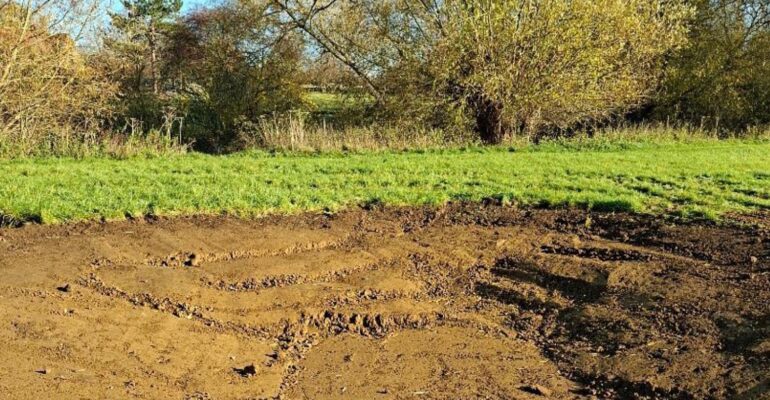
From the August and September reports. SRT have now created the pond on Cornmill Meadows, in accordance with the agreement with STC. Although there is a channel link to Pig Brook, the size and capacity of the pond won’t be sufficient to deliver any real flood mitigation benefits.
As an observation, the channel cuts through the mowed path area on the Pig Brook side of the meadow and will prevent its use as a circular route round the green space. The permissive footpath to Willington can still be accessed from the path on the other side of the meadow.
Some photos are enclosed at the end of the report.
From the September report. After John Dinnie resigned as a councillor, STC appointed Councillor Vanessa Benjamin-Smith as Chair of the SAFAG working group, with John Dinnie assisting. There are no other changes to the team roles and responsibilities.
From the October report. With the repairs on the leaky woody dams on Stretton Brook in hand, Mike McCarthy and Ben Goren arranged an on-site meeting with the landowner to discuss some slight modifications to the planned works, primarily to address the identified concern about water erosion to the banks of the watercourse around the affected dams. Addressing this (boarding and extra protective posts) won’t affect the quote from Joe Dee which was approved at the October meeting. The landowner is a well-known local farmer and a long-standing councillor on Brailes Parish Council. A very useful contact, who is receptive to discussing bunds and/or ponds next year.
From the October report. WCC Councillor Dale Bridgewater has responded to the request for a meeting. This has been arranged for 6th November at Shire Hall in Warwick. Mike McCarthy, Brian Cooper and John Dinnie will be attending. It’s an opportunity to discuss funding opportunities from the Regional Flood and Coastal Committee (RFCC) and WCC’s Flood Risk Management Strategy.
From the October report. To measure performance against target, a record has been created to monitor how many interventions are assessed versus the annual objective of 290. The first period is April 2025 to March 2026, which matches STC’s financial year. So far, 145 have been inspected (142 dams, 2 ponds and 1 wetland area). Of those, 27 dams required repair/upgrade at a total net cost of £9,220. In addition, 2 ponds were desilted by the landowner. STC will be regularly updated with progress.
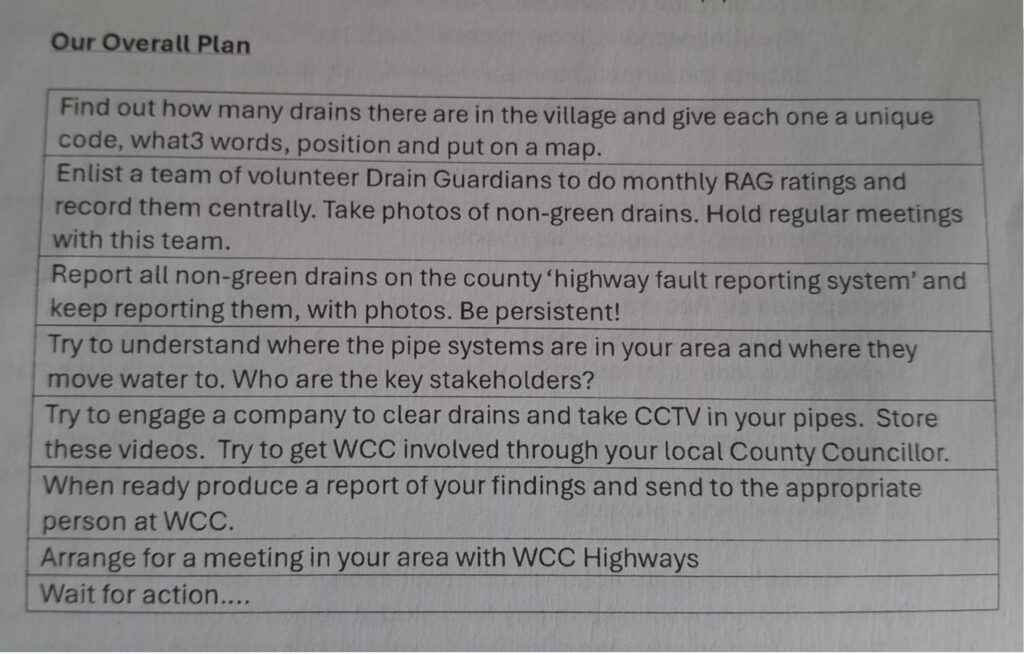
Great Alne Structured Plan. RAG ratings-R-Red, A-Amber, G-Green.
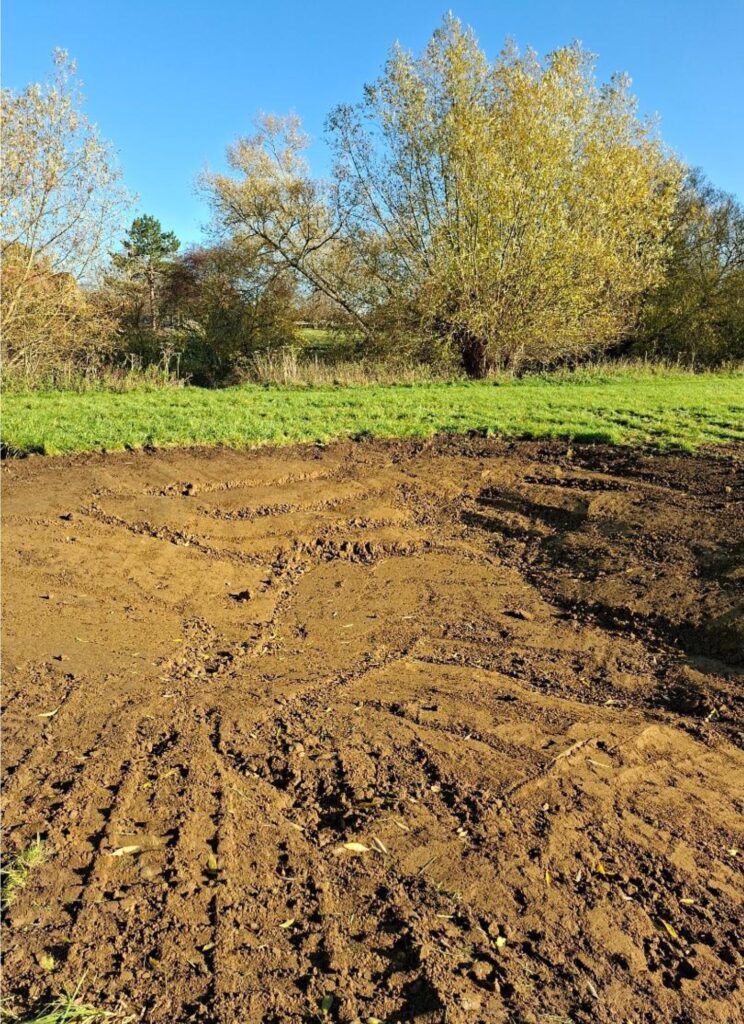
the background.
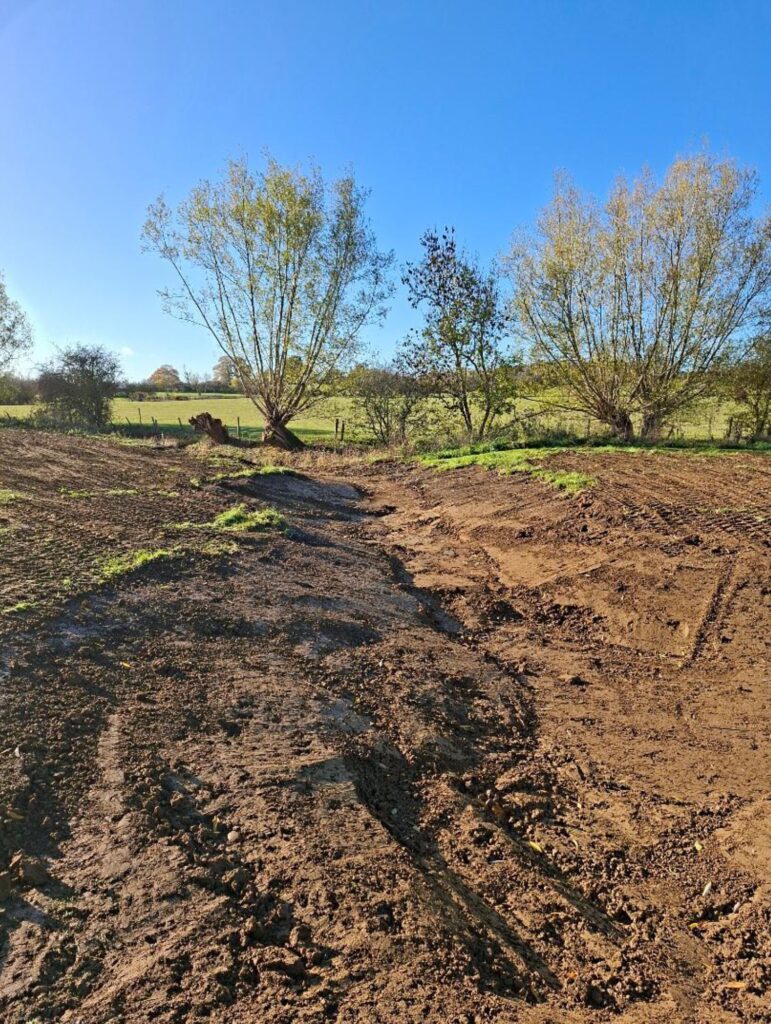
the tree line in the background
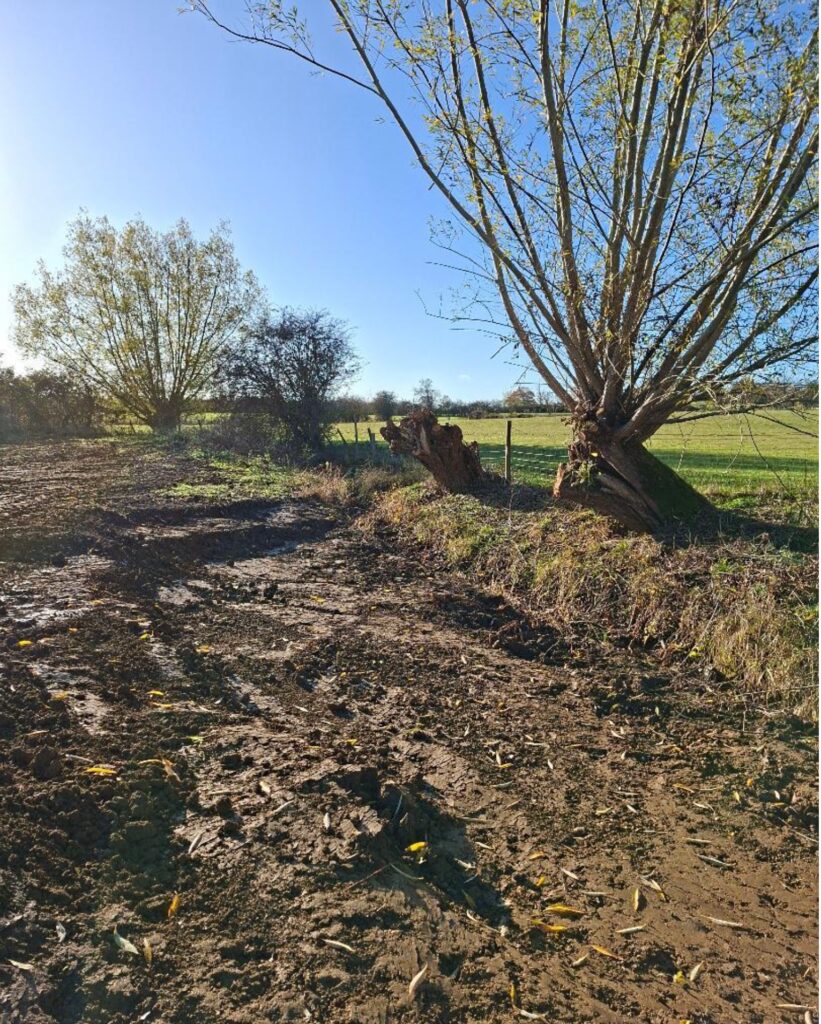
through the mowed path which borders Pig Brook and is part of the circular walk around the
greenspace. It will render this section of the path impassable. Pig Brook is in front of the
willow tree.

Comments are closed.